
GoWind WMS Product Overview
GoWind WMS is an enterprise-grade open-source warehouse management system (WMS) for small and mid-sized 3PL warehouses, e-commerce warehouses, and factory finished-goods warehouses, with native support for multi-owner and storage-bin-level inventory management; its inventory engine draws on Odoo's stock.quant / picking / move modeling ideas.
GoWind WMS is derived from the inventory module of GoWind ERP, sharing the same stack and origin, and is open-sourced under the MIT license. Trials, feedback, and contributions are welcome; for private deployment and technical support services, please contact us via the information at the end of this page.
Release notes
The open-source edition's features are fully implemented and have passed end-to-end smoke acceptance; the official release is in preparation. Capabilities such as the billing engine and third-party platform integrations are planned for the commercial edition.
1. Core Highlights
1. Multi-owner inventory isolation
- Native 3PL support: owners are modeled as first-class concepts, so one warehouse can serve multiple owners
- Data isolation: inventory and documents are isolated by owner — invisible to and unaffected by each other
- One warehouse, many owners: fits the real shape of 3PL warehouses running multiple clients in a shared facility
2. Odoo-style inventory engine
- quant / picking / move modeling: drawing on the mature Odoo stock model, inventory is traceable and every movement has a document
- Batches and shelf life: batch management with FEFO (First-Expired-First-Out) deduction
- Moving average cost: moving-average costing, rolling forward automatically with each inbound and outbound movement
3. End-to-end ASN arrival appointments
- Arrival appointments: owners submit an ASN (Advanced Shipping Notice) in advance, so inbound plans come first
- Declaration and receiving: arrivals are declared and confirmed on site, received against appointment details with over-receiving prevented
- Putaway suggestions: putaway suggestions are generated after receiving, so every putaway has a basis
4. Wave picking outbound
- Direct release of outbound orders: outbound orders can be released for execution once validation passes
- Wave consolidation: picking tasks are merged into wave picking and executed in batches, improving picking efficiency
- Wave debugging: a wave debugging view makes execution observable and troubleshootable
5. SaaS subscription and quota guardrails
- Subscription management: subscription management for SaaS-style operations
- Quota guardrails: usage is automatically blocked once the quota is reached, keeping resource consumption under control
- Approval track: key documents follow the unified approval track, fully logged and queryable
2. Feature Overview
Inbound
| Feature | Description |
|---|---|
| ASN arrival appointment | Owners book inbound plans in advance |
| Arrival declaration | On-site declaration and confirmation of arrivals |
| Over-receiving protection | Receiving against appointment details, preventing over-receipt |
| Putaway suggestions | Generated after receiving |
Outbound
| Feature | Description |
|---|---|
| Direct order release | Outbound orders are released for execution once validated |
| Outbound validation | Inventory and other checks completed before release |
| Wave consolidation & execution | Picking tasks merged into wave picking and executed in batches |
Inventory operations
| Feature | Description |
|---|---|
| FEFO batch / shelf-life deduction | First-Expired-First-Out by batch shelf life |
| Inventory freeze & outbound blocking | Frozen inventory is automatically blocked from outbound |
| Inventory aging report | Bucketed statistics at 30 / 60 / 90 / 180+ days |
| Cross-warehouse transfers | Transfer orders execute atomically as transactions |
| Idempotent reversals | Reversal operations are idempotent — safe error correction |
Multi-owner and subscription
| Feature | Description |
|---|---|
| Owner isolation | Inventory and documents isolated by owner |
| Approval track | Key documents approved uniformly with a full audit trail |
| Subscription quotas | SaaS subscription and quota guardrails |
Platform
| Feature | Description |
|---|---|
| i18n | Chinese / English / Japanese trilingual UI |
| Auditing | Operation audit trail |
3. UI Preview
Login and workbench
| Login page | Workbench |
|---|---|
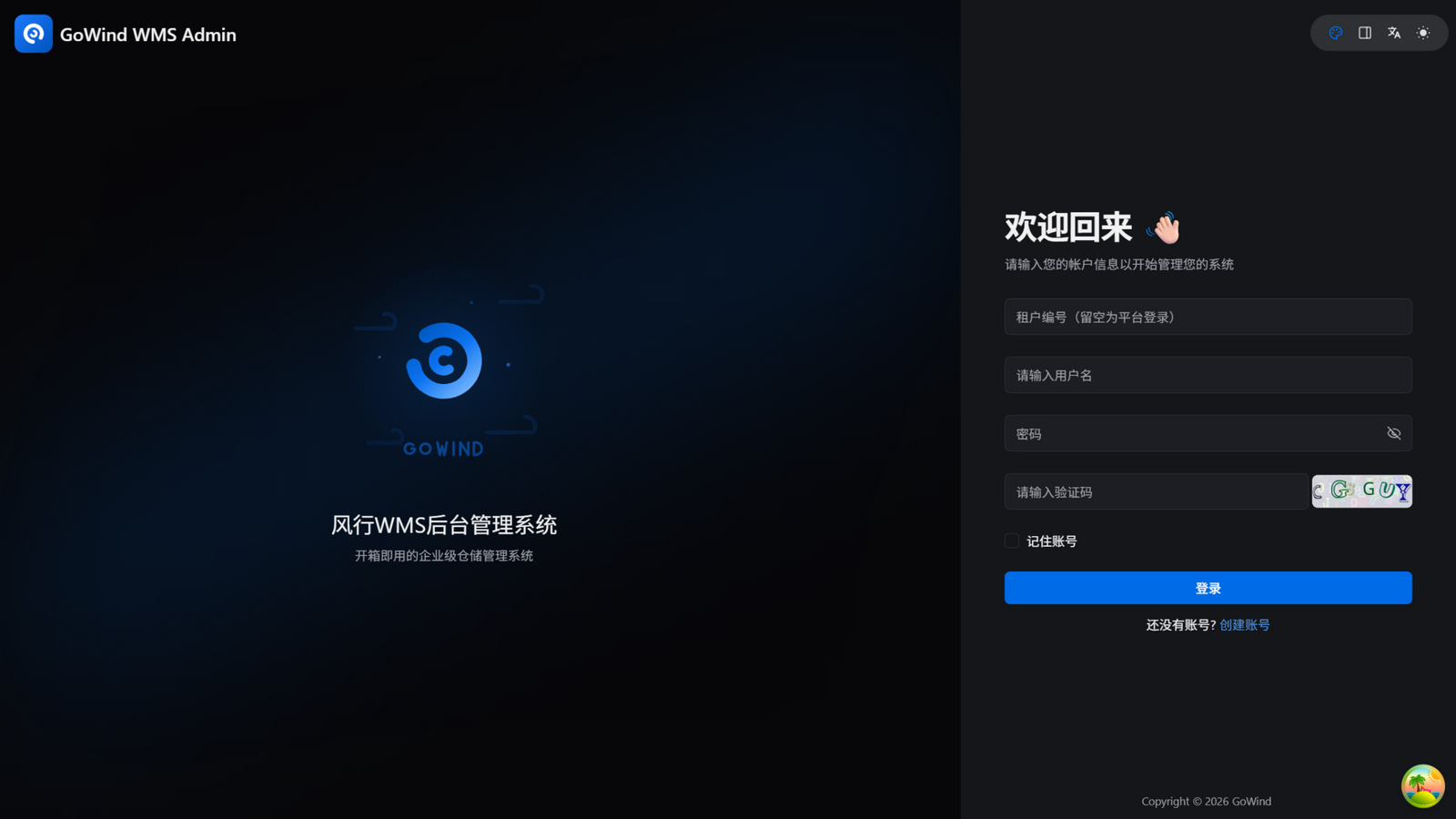 | 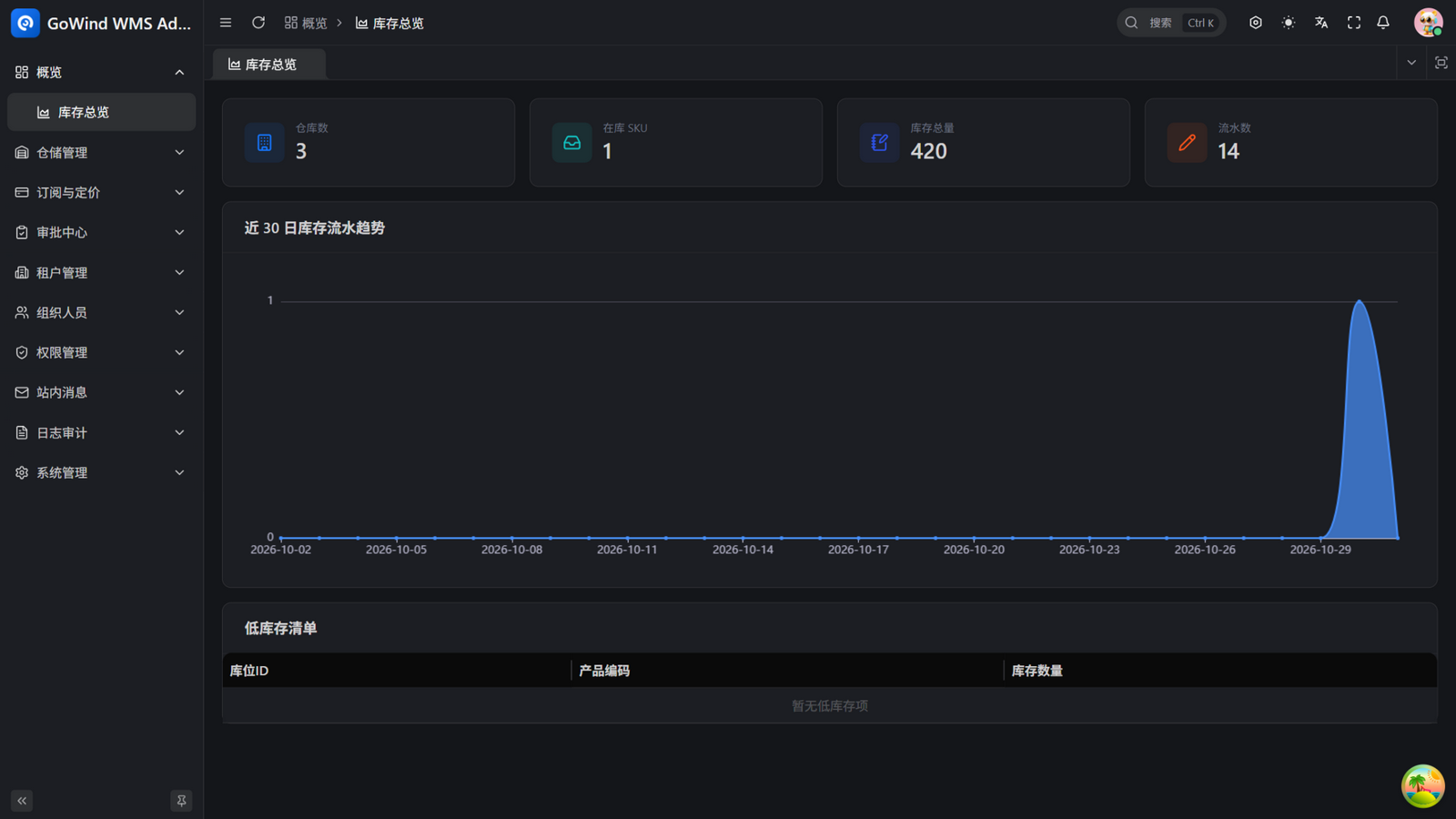 |
Warehouses and inbound
| Warehouse management | ASN arrival appointment |
|---|---|
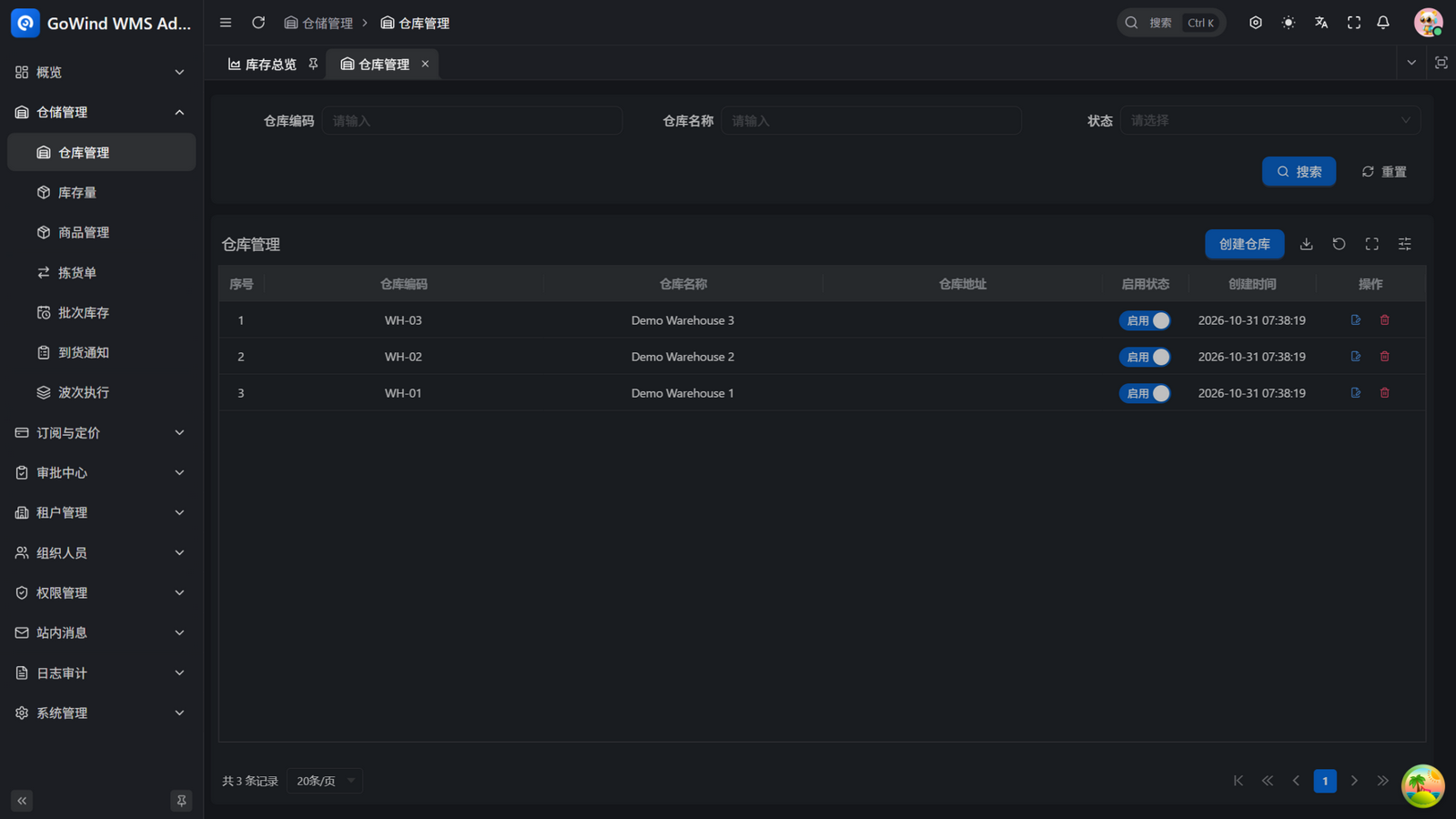 | 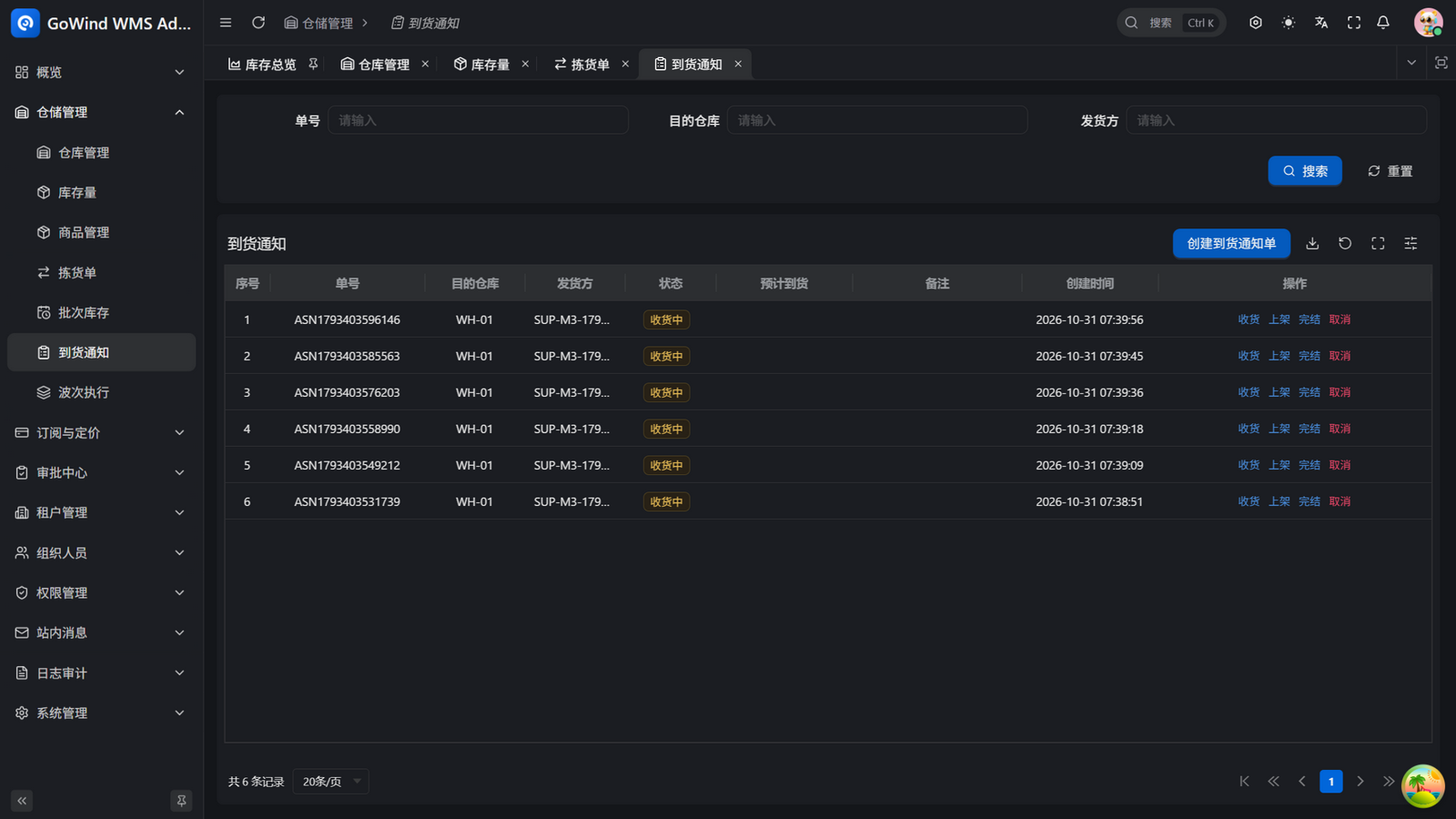 |
Picking and waves
| Picking management | Wave management |
|---|---|
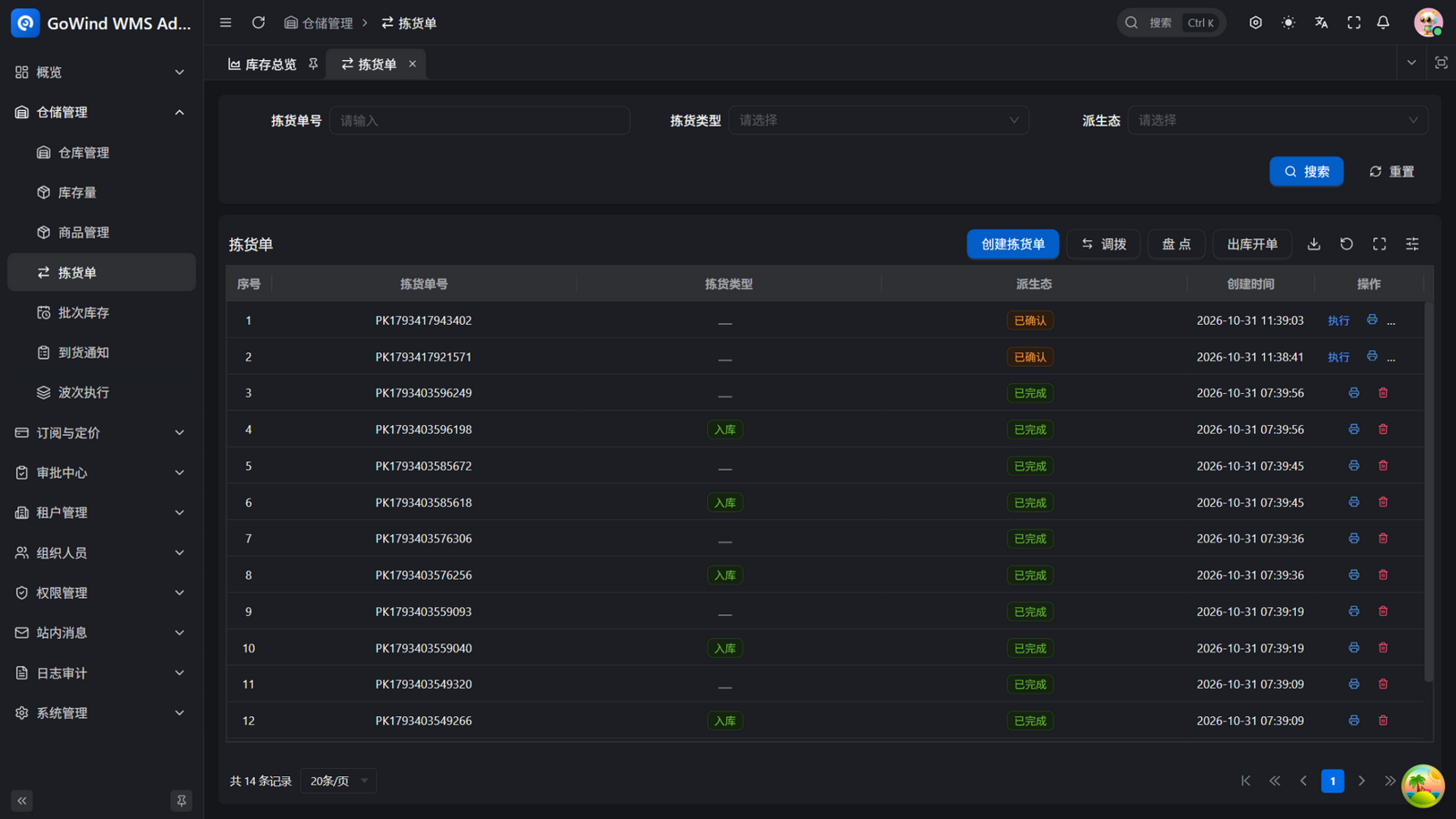 | 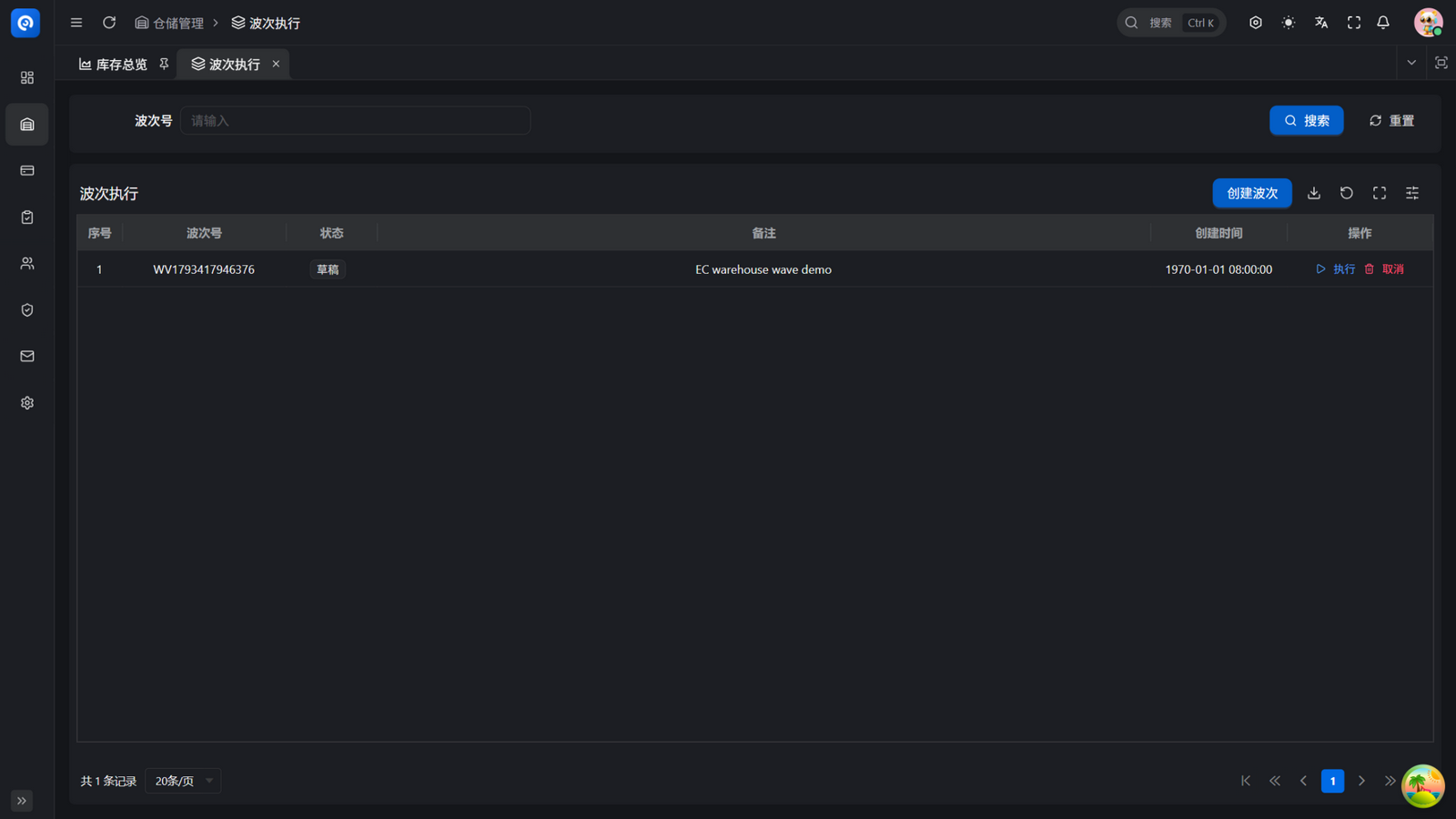 |
Wave debugging and inventory
| Wave debugging | Inventory query |
|---|---|
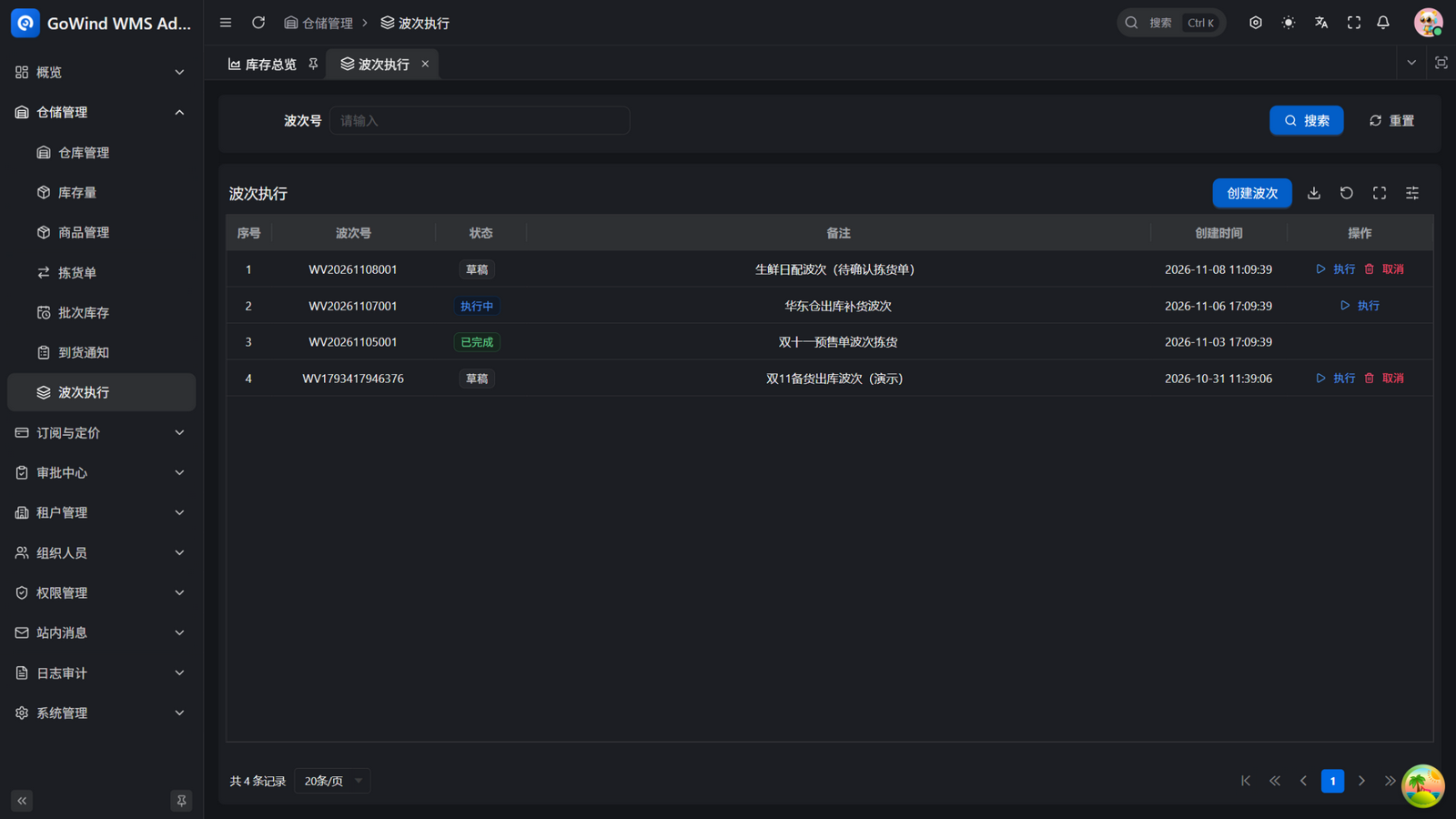 | 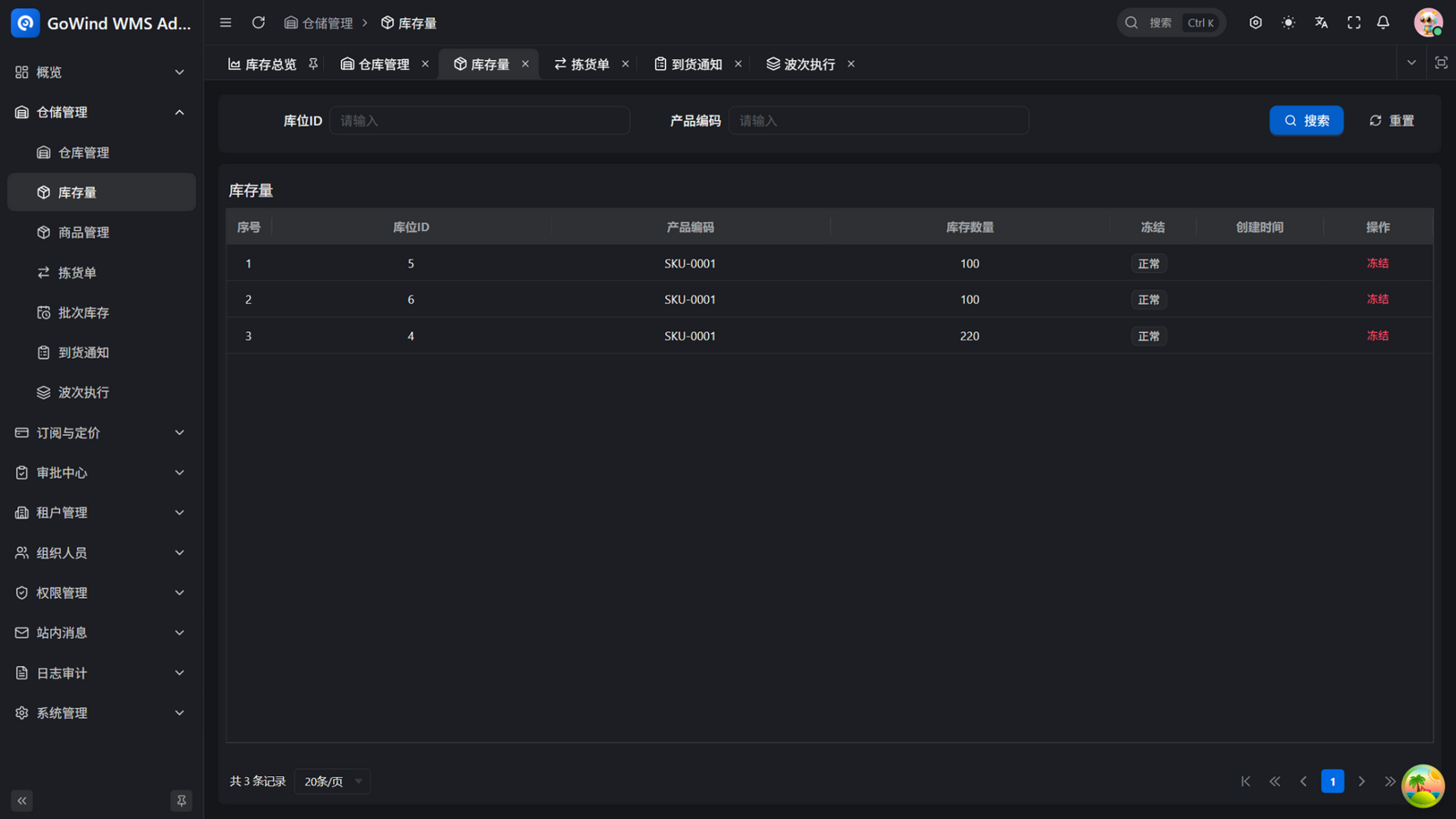 |
4. Use Cases
Small and mid-sized 3PL warehouses
- Multi-owner shared-warehouse operations, with data natively isolated per owner
- ASN arrival appointments + over-receiving protection keep inbound orderly
- Storage-bin-level management: precise slot positioning and clear operation paths
- SaaS subscription and quota guardrails make serving multiple owners easier
E-commerce warehouses
- Wave picking consolidates picking tasks and executes them in batches to handle order peaks
- FEFO batch shelf-life deduction — first-expired-first-out
- Inventory aging report bucketed at 30 / 60 / 90 / 180+ days makes slow-moving stock visible at a glance
- Chinese / English / Japanese trilingual UI fits cross-border e-commerce and overseas warehouse teams
Factory finished-goods warehouses
- Storage-bin-level management across the full inbound/outbound flow of finished goods
- Inventory freezing and outbound blocking keep abnormal stock under control
- Atomic cross-warehouse transfers keep books and stock consistent across warehouses
5. Tech Stack and Deployment
The GoWind WMS backend is built on the go-kratos microservice framework, uses Ent as ORM, and uses gRPC for inter-service communication; the admin console is built on Vue3, and field operations are equipped with a Flutter PDA (handheld scanner) client (adapted to industrial handheld terminals).
Deployment mirrors GoWind ERP: docker-compose brings up the same set of middleware (PostgreSQL, Redis, MinIO, etcd, bound to 127.0.0.1), while the application side provides two service entries: admin BFF (:6600) and app BFF (:6700). For detailed deployment steps, see the docs/deployment.md deployment documentation in the repository.
Both the inventory modeling and the deployment form of the WMS originate from GoWind ERP; to learn more, see the GoWind ERP Product Overview.
6. Open-Source Repository and Contact
| Entry point | Address |
|---|---|
| Source repository (GitHub) | https://github.com/tx7do/go-wind-wms |
| Public demo site | Not yet available; follow the deployment docs to try it locally |
For developers: clone the repository and follow docs/deployment.md to complete a local deployment. Issues and PRs are welcome for co-building.
Contact Us
Reach us on WeChat at yang_lin_bo (remark: go-wind-wms), or by email at yanglinbo@gmail.com, to discuss product features, contribution and co-building, private deployment services, and related topics.