GoWind Kanban
GoWind Kanban is a real-time collaborative kanban system that organizes team tasks and field operations around "boards + lists + cards". The system is architected for free switching between microservices and a monolith and achieves real-time multi-client sync via SSE / WebSocket; the mobile client is built on Flutter with one codebase compiled for six platforms (iOS / Android / Web / macOS / Windows / Linux), optimized for frontline and field work scenarios with offline-first support.
If you are looking for an alternative to Focalboard (Mattermost Boards), GoWind Kanban is worth a try. The project is open-sourced under the MIT license, and trials, feedback, and contributions are welcome.
Rapid iteration in progress
GoWind Kanban is under rapid iteration; the user manual and deployment documentation are still being improved. If you run into issues, please report them via repository Issues — contributions are also very welcome.
1. Core Highlights
1. Board Management
- Boards / lists / cards: everything needed to create and edit boards, lists, and cards;
- Drag-and-drop transitions: dragging a card across lists completes the status transition — zero learning cost.
2. Label Management
- Label system: use labels to mark a card's type, priority, or ownership;
- Flexible organization: group and filter tasks by label within a board to stay focused on priorities.
3. Real-Time Cross-Client Sync
- SSE / WebSocket dual channel: card creation, moves, and edits are broadcast to all collaborators in real time;
- Consistent across devices: the web console and the mobile app always show the same board state — collaborators never overwrite each other.
4. Offline-First
- Usable on weak networks: optimized for frontline and field work — keep working even when the network is unstable;
- Field-friendly: keep collecting offline; sync resumes automatically once back online — a fit for workshops, construction sites, and field service.
5. Multi-Tenancy and Permissions
- Multi-tenant isolation: multiple teams and business lines share one deployment, with data isolated between them;
- RBAC permissions: access control refined to the menu, button, and data level.
6. Platform Foundation Capabilities
- Out-of-the-box foundation: built-in dictionary management, task scheduling, login policies, i18n, and in-app messaging;
- Five categories of audit logs: key operations are fully logged, covering operations troubleshooting and compliance needs.
2. Feature Overview
| Feature domain | Key capabilities |
|---|---|
| Kanban collaboration | Creation and editing of boards / lists / cards, drag-and-drop card transitions, label management |
| Real-time sync | SSE / WebSocket real-time multi-client sync with consistent state everywhere |
| Offline capability | Offline-first; usable on weak networks and in the field |
| Tenancy and permissions | Multi-tenant isolation, RBAC (menu / button / data level) |
| Platform foundation | Dictionary management, task scheduling, login policies, i18n, in-app messaging, five categories of audit logs |
3. UI Preview
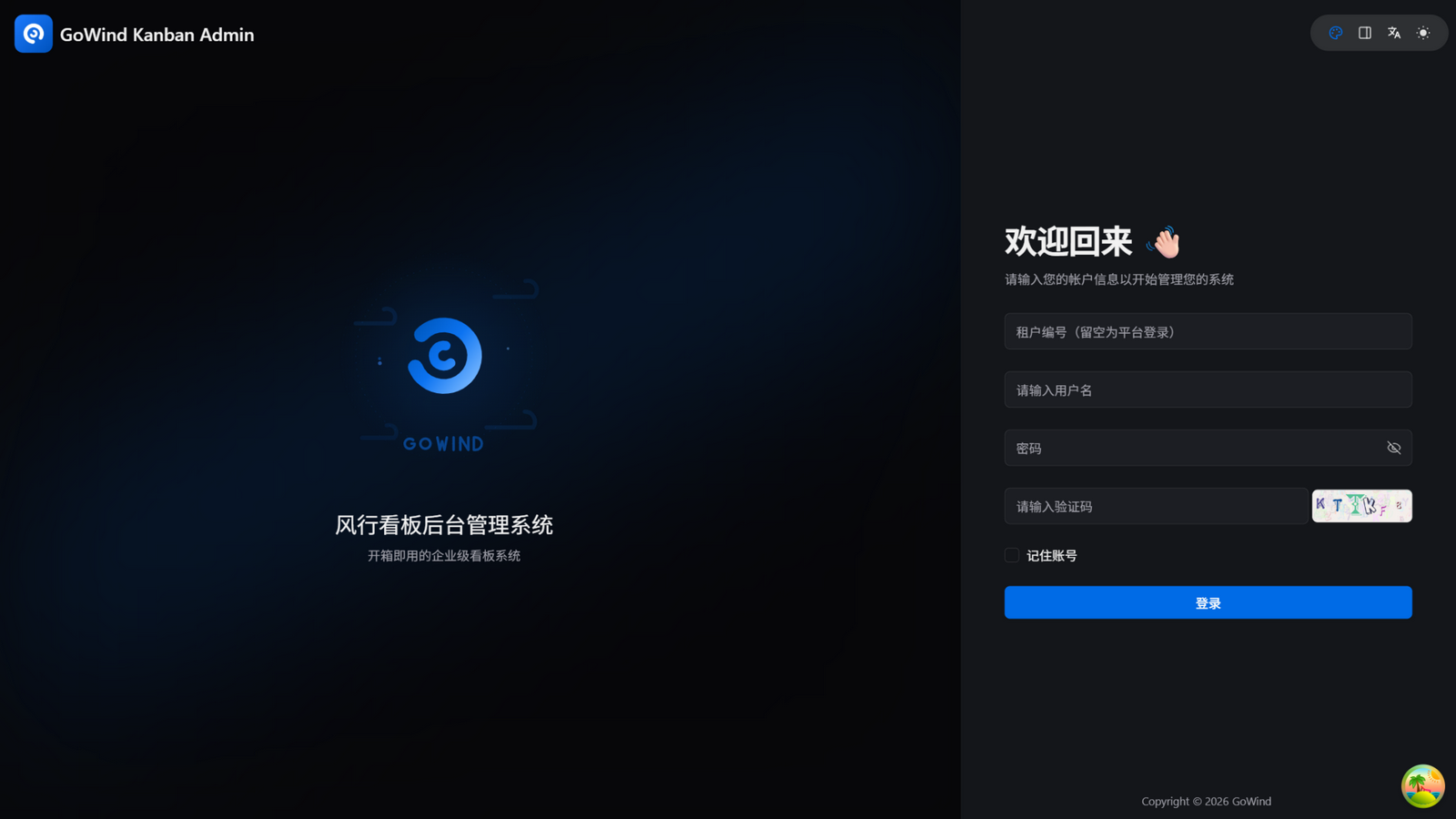
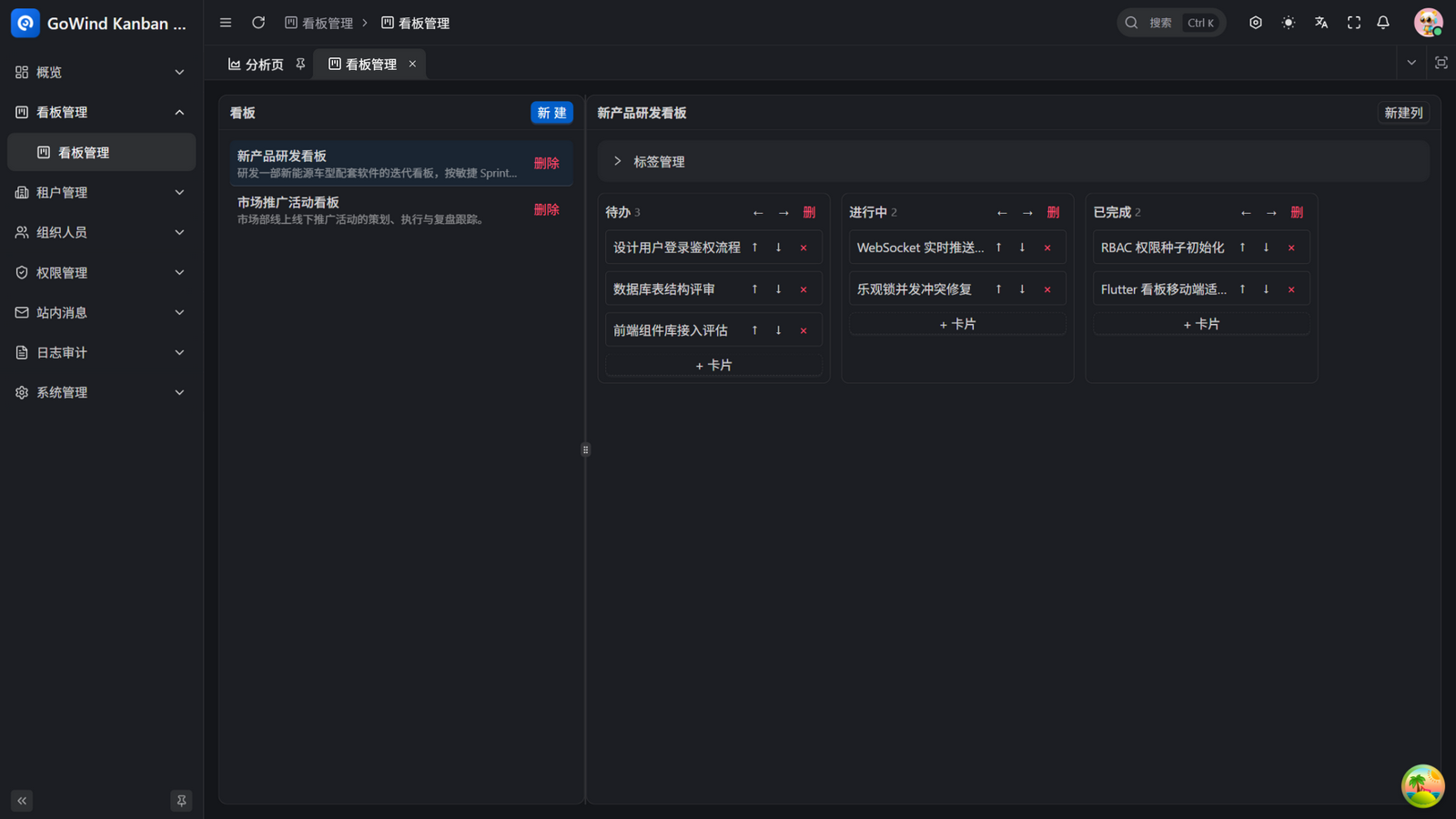
Admin Console (Vue3 + Ant Design Vue + Vben Admin)
 |  |
|---|---|
| Login page | Board management |
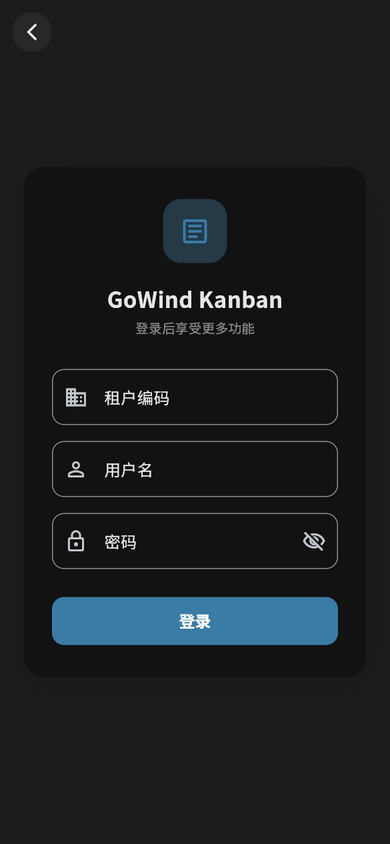
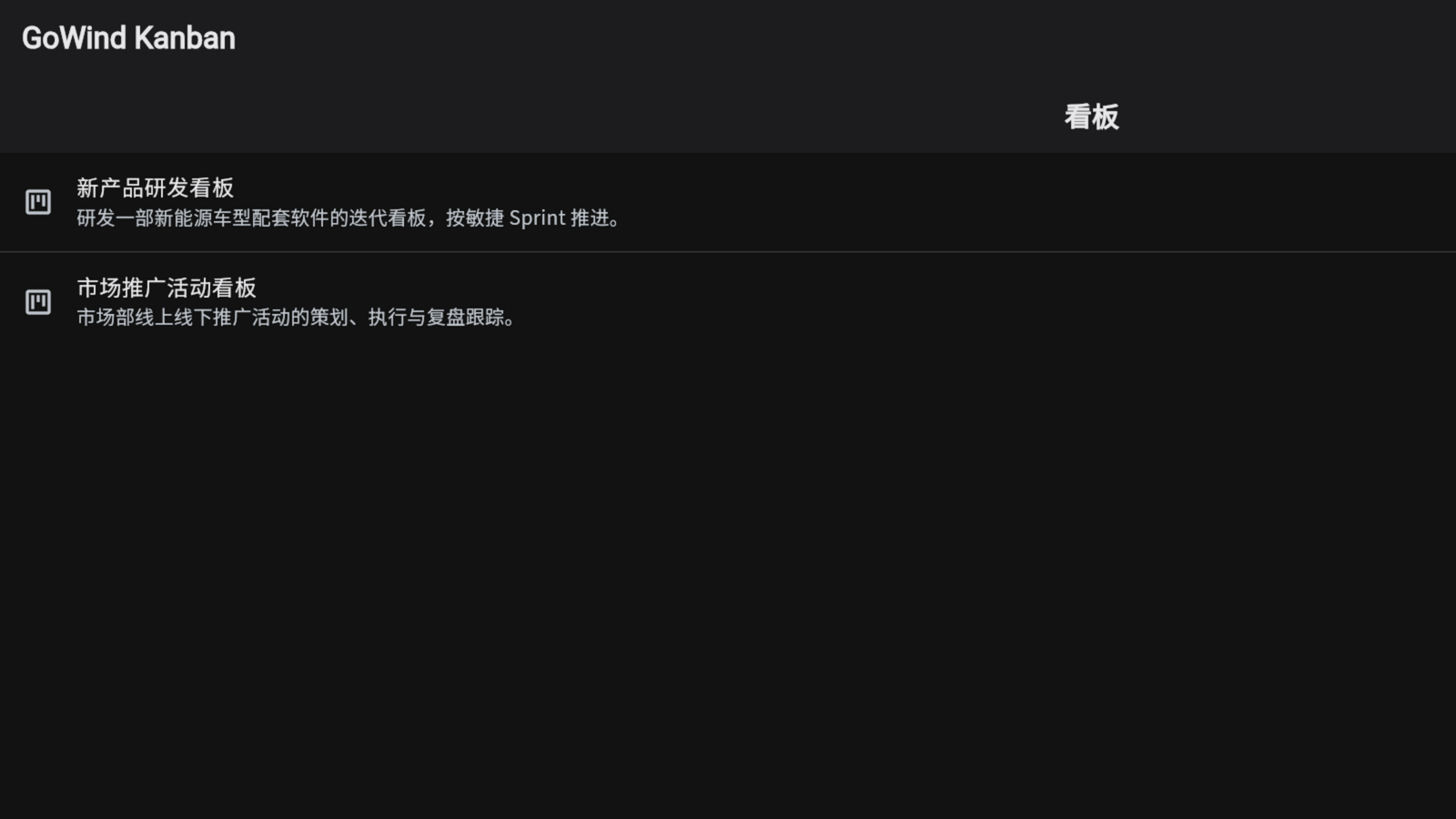
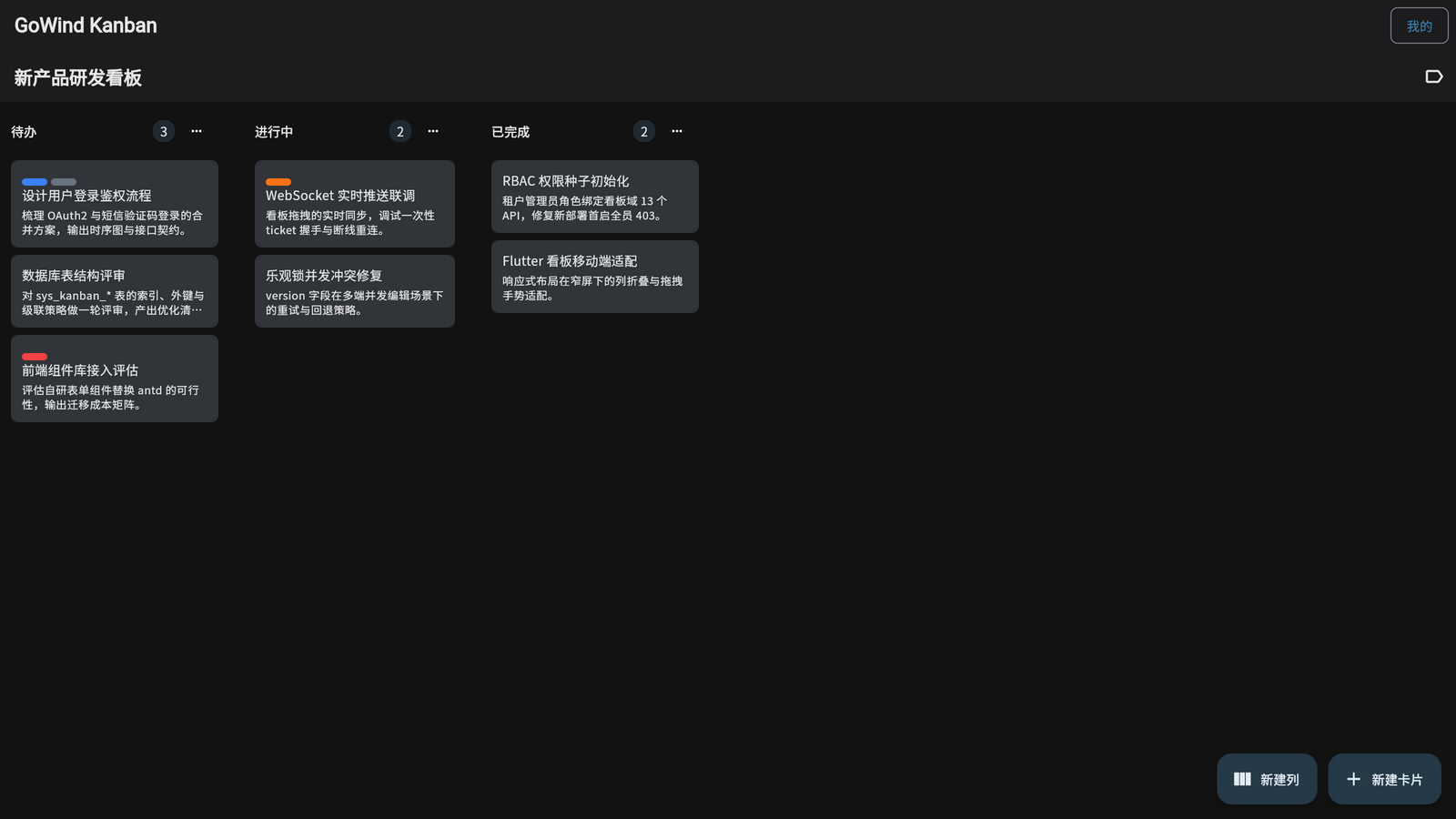
Mobile App (Flutter, one codebase compiled for six platforms)
 |  |
|---|---|
| App login | App board list |
 | |
|---|---|
| App board view |
4. Use Cases
Frontline and field operations
Designed for frontline settings — workshops, construction sites, stores, field service:
- Offline-first: kanban work continues on weak or lost networks;
- One Flutter codebase covering phones, desktops, and the web — field devices work right after install;
- Data syncs automatically once back online, so the back office sees field progress in real time.
Team task collaboration
Kanban-driven task management for small teams:
- Drag cards to change status; use labels for priority and ownership;
- SSE / WebSocket real-time sync — zero lag between team members.
Focalboard replacement and self-hosting
Replace the unmaintained Focalboard (Mattermost Boards):
- MIT open source, self-hostable — data fully under your control;
- Free switching between microservices and monolith, scaling smoothly from a personal deployment to an enterprise cluster.
One deployment shared by multiple teams
A multi-tenant architecture supporting parallel business lines:
- Data of multiple teams and business lines is mutually isolated;
- Menu-, button-, and data-level RBAC permissions assigned as needed.
5. Tech Stack and Deployment
The backend is built on the go-kratos framework, uses Ent ORM for data access, and stores business data in PostgreSQL, supporting free switching between the microservice and monolith forms; the admin console is built on Vue3, Ant Design Vue, and Vben Admin, and the mobile app is developed with Flutter, one codebase compiled for iOS / Android / Web / macOS / Windows / Linux — six platforms in total.
| Component | Description |
|---|---|
| Backend | go-kratos + Ent + PostgreSQL, free switching between microservices and monolith |
| Admin console | Vue3 + Ant Design Vue + Vben Admin |
| Mobile app | Flutter, one codebase compiled for six platforms |
| Real-time channel | SSE / WebSocket |
| Deployment | docker-compose supports two modes: full_deploy (one-shot deployment of middleware + applications) and libs_only (middleware only, recommended for development and debugging) |
6. Open-Source Repository and Contact
GoWind Kanban is open-sourced under the MIT license. There is currently no public demo site; you can deploy it locally to try it out.
| Entry point | Address |
|---|---|
| Source repository (GitHub) | https://github.com/tx7do/go-wind-kanban |
Contact Us
Reach us on WeChat at yang_lin_bo (remark: go-wind-kanban), or by email at yanglinbo@gmail.com, to discuss product features, issue reports, contribution and cooperation, and related topics.