
GoWind CDC (Data Pipeline)
GoWind CDC is the "data glue" of the GoWind ecosystem: a lightweight data sync and migration pipeline built for B2B delivery scenarios, solving three pain points at once — migrating legacy system data, real-time cross-system integration, and compliance masking.
The fundamental difference from Canal / Debezium / DataX: pure Go, no JVM, no hard Kafka dependency — a single process serves as both the CDC engine and the management service. One server is enough; no extra middleware cluster to set up on delivery sites.
Version note
Core capabilities — capture, mapping, masking, data audit, alerting, schema-change sync, bidirectional sync — are fully implemented and have passed end-to-end acceptance (current release 1.2.0). The product is in rapid iteration; capabilities keep growing.
Three Delivery Stories: How GoWind CDC Works
Story one: the legacy migration. A factory's ERP runs on a ten-year-old SQL Server; management wants it moved to a modern platform — without stopping the business. With GoWind CDC: a full snapshot moves the existing data first, then incremental catch-up streams every change made during the migration. The old system keeps running until one night the data aligns completely and a single cutover finishes the job. The legacy system retires, and nobody worked overtime.
Story two: real-time integration. The order database and the data warehouse used to sync through nightly batches, so reports always lagged a day. A real-time pipeline fixes it: an order lands in the source database and appears in the warehouse seconds later. The target database goes down mid-stream? Resumable sync buffers data locally and catches up automatically when it returns — nothing lost. One day the source adds a new table: runtime table attach hot-mounts it without stopping the pipeline.
Story three: compliant egress. The dev team needs a copy of production data for testing, but phone numbers and ID numbers cannot leave. A masking pipeline handles it: phones masked, IDs starred, join-friendly fields replaced with deterministic algorithms — the data stays usable in dev but is no longer real personal information. The compliance review passes.
Highlights
- Pure Go kernel, full source-target matrix: sources include MySQL Binlog (GTID resumption), PostgreSQL WAL, SQL Server (trigger/timestamp templates + MS CDC log-level capture), Oracle (LogMiner), and MongoDB (Change Streams); targets cover MySQL / PostgreSQL / Kafka / ClickHouse / Elasticsearch / Redis — the common combinations are all covered
- Single-box deployment: no JVM, no hard Kafka dependency; one core process is both engine and management API — it even fits the "one Windows server in the government machine room" reality
- Resumable, lossless sync: local durable queue with disk-streamed buffering; memory does not grow even during long target outages, and catch-up is automatic
- Schema changes travel with the data: source add/rename/drop column flows through DDL sync idempotently, with history
- Bidirectional sync without loops: A↔B hot-standby pairs get automatic loop-back markers, so data never ping-pongs
- Incremental audit & one-click repair: full baseline + incremental watermark + sampled checks in three tiers; block-level diff lists, point repair, CSV consistency reports
- One-click masking with national crypto: 10 algorithms — phone masking, ID masking, hashing, date shift, range replace, SM3 digest — compliance by default (commercial-edition capability)
- Enterprise governance built in: RBAC permissions, operation audit logs, multi-tenancy, and a bilingual interface out of the box — meeting the compliance and control requirements of government and enterprise private delivery
- Alerts that reach people: latency, backlog, and disconnects pushed via Feishu / DingTalk / WeCom / email, with a per-delivery ledger and one-click resend
Feature Overview
1. Capture & Source Adapters
| Feature | Description |
|---|---|
| Real-time capture | Native MySQL Binlog (GTID-supported, survives primary failover) and PostgreSQL WAL listening |
| Legacy templates | SQL Server trigger / timestamp / MS CDC log-level modes, Oracle LogMiner, MongoDB adapters |
| One-click shadow table | Auto-generated _cdc_log shadow table plus I/U/D trigger scripts |
| Wildcard subscription | Subscribe by database/table prefix; new tables discovered periodically |
| Three sync modes | Real-time, full snapshot, and full + incremental, chosen per scenario; snapshot chunks can be rate-limited to ease source load in off-peak windows |
| Resumable positions | Four checkpoint kinds persisted; local disk-buffered streaming — long outages lose nothing |
| Sharded-merge | Multiple shard sources merged into one target table |
2. Transform & Write
| Feature | Description |
|---|---|
| Zero-code mapping | Drag-to-connect field alignment with type conversion |
| Schema auto-migration | Target tables created automatically with source types mapped to the target dialect; missing columns are added automatically — no manual alignment |
| Row filters & expressions | Simple expression filtering and lightweight field computation |
| Dynamic masking (Commercial) | 10 algorithms — masking, hashing, date shift, range replace, SM3 — with conditional rules |
| DDL sync | Source schema changes followed automatically, executed idempotently, fully historized |
| Bidirectional sync | Loop-back markers for A↔B hot-standby pairs — no data ping-pong |
| Cache refresh | Redis target refreshes cache entries by key template with TTL |
| Transactional Kafka writes | Kafka target supports transactional Exactly-once production — no duplicates, no losses |
3. Operations
| Feature | Description |
|---|---|
| Runtime table attach | Hot-mount new tables without stopping the pipeline |
| Per-table re-snapshot | Re-snapshot one missed table without re-running the whole pipeline |
| Pipeline lease | Multi-instance deployment with lease-based single-writer protection |
| Standalone collector node | Deploy across network segments: the collector holds no target credentials, buffers locally for resumable sync, and reports its version for inspection |
| Overview dashboard | Task status, throughput, latency, and backlog on one auto-refreshing screen with quick links |
| Pipeline metrics | Latency (P50/P95), backlog, event and per-table metrics, and snapshot progress in real time |
| Task orchestration | Draft / starting / running / paused / error / stopped — fully visible and controllable |
4. Data Audit (Commercial)
| Feature | Description |
|---|---|
| Full baseline comparison | Chunked row-count + checksum comparison, dialect-agnostic |
| Incremental watermark checks | Watermark-column-based incremental comparison; first run doubles as the baseline |
| Sampled checks | Deterministic proportional sampling for low-cost daily verification |
| Diff location & repair | Block-level diff lists, row-level detail (source_only / target_only / changed), one-click point repair |
| Heterogeneous repair | Semantics-aware repair into Elasticsearch, ClickHouse and other targets |
| Consistency reports | CSV export for delivery acceptance evidence |
5. Alerting & Ecosystem
| Feature | Description |
|---|---|
| Alert rules | Global and per-task rules across latency / backlog / disconnect metrics |
| Multi-channel delivery | Feishu, DingTalk, WeCom robots and SMTP email |
| GoWind IM integration | Precise error messages pushed to IT ops via IM robots |
| Delivery ledger | Every dispatch recorded; failed deliveries resend in one click |
| Agent scripts (Commercial) | Describe a cleansing need in natural language and get ETL rules generated (GoWind Agent integration) |
Screenshots
Overview & Datasources
| Overview | Datasources |
|---|---|
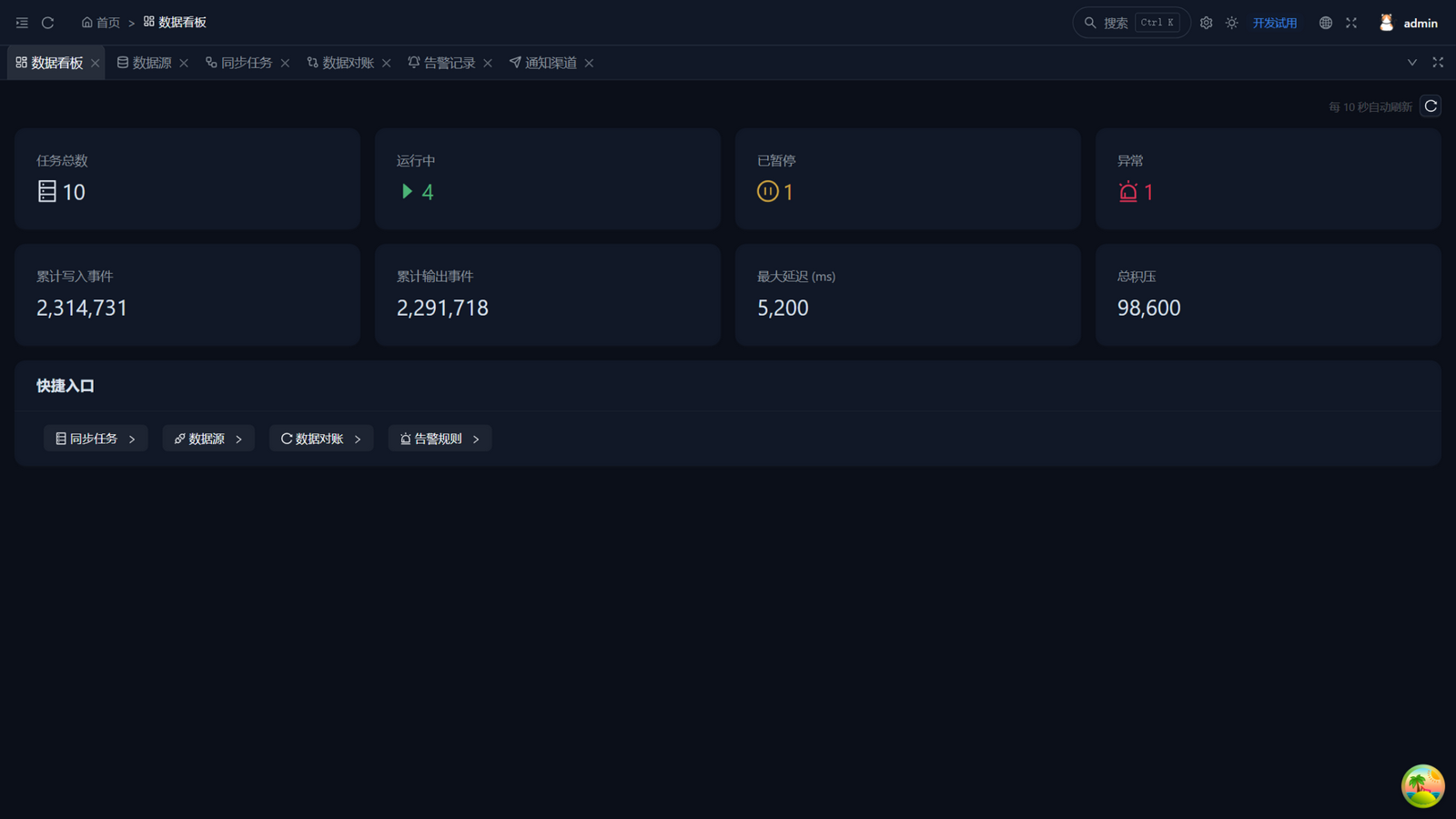 | 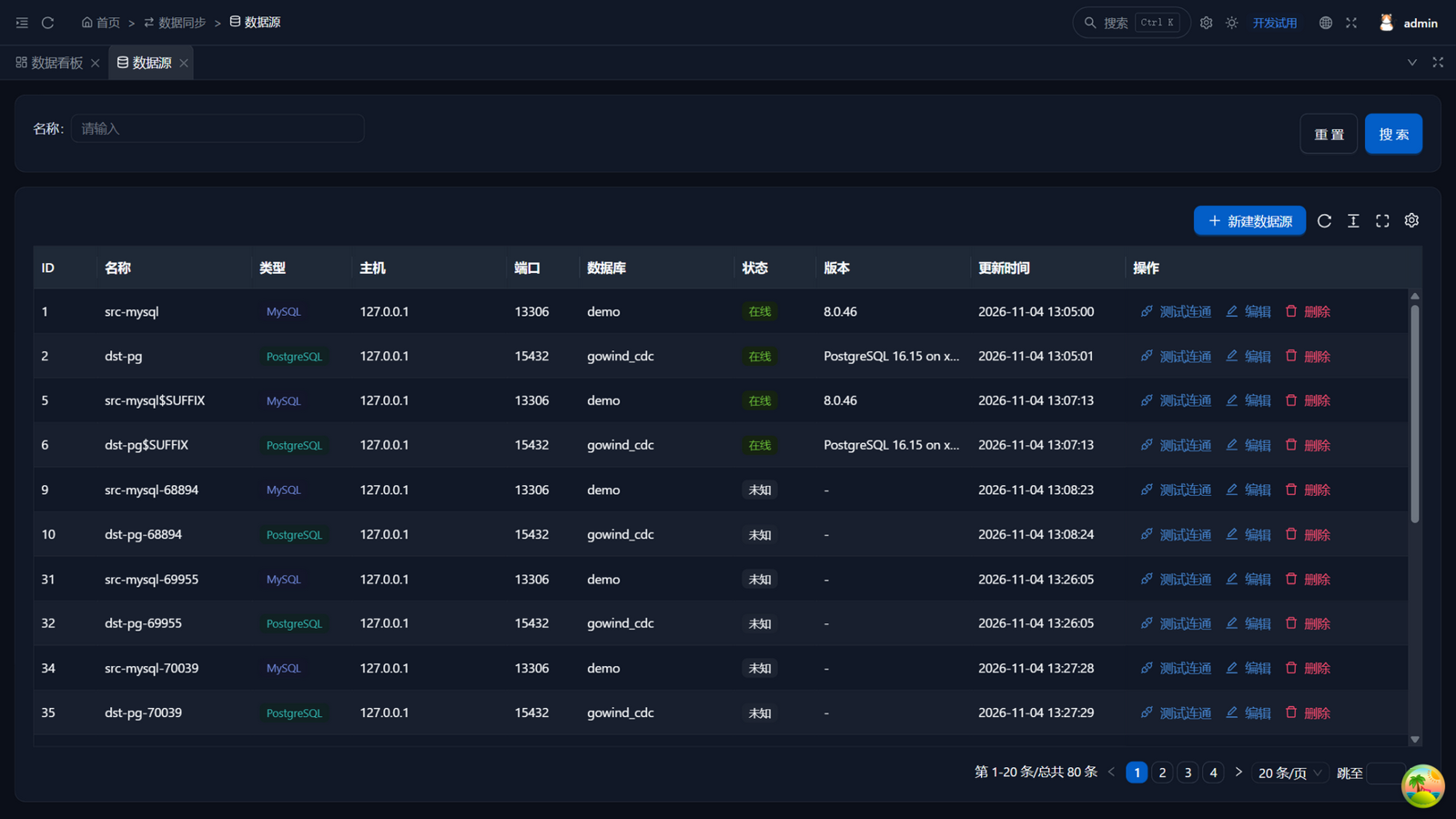 |
Sync & Audit
| Pipelines | Data Audit |
|---|---|
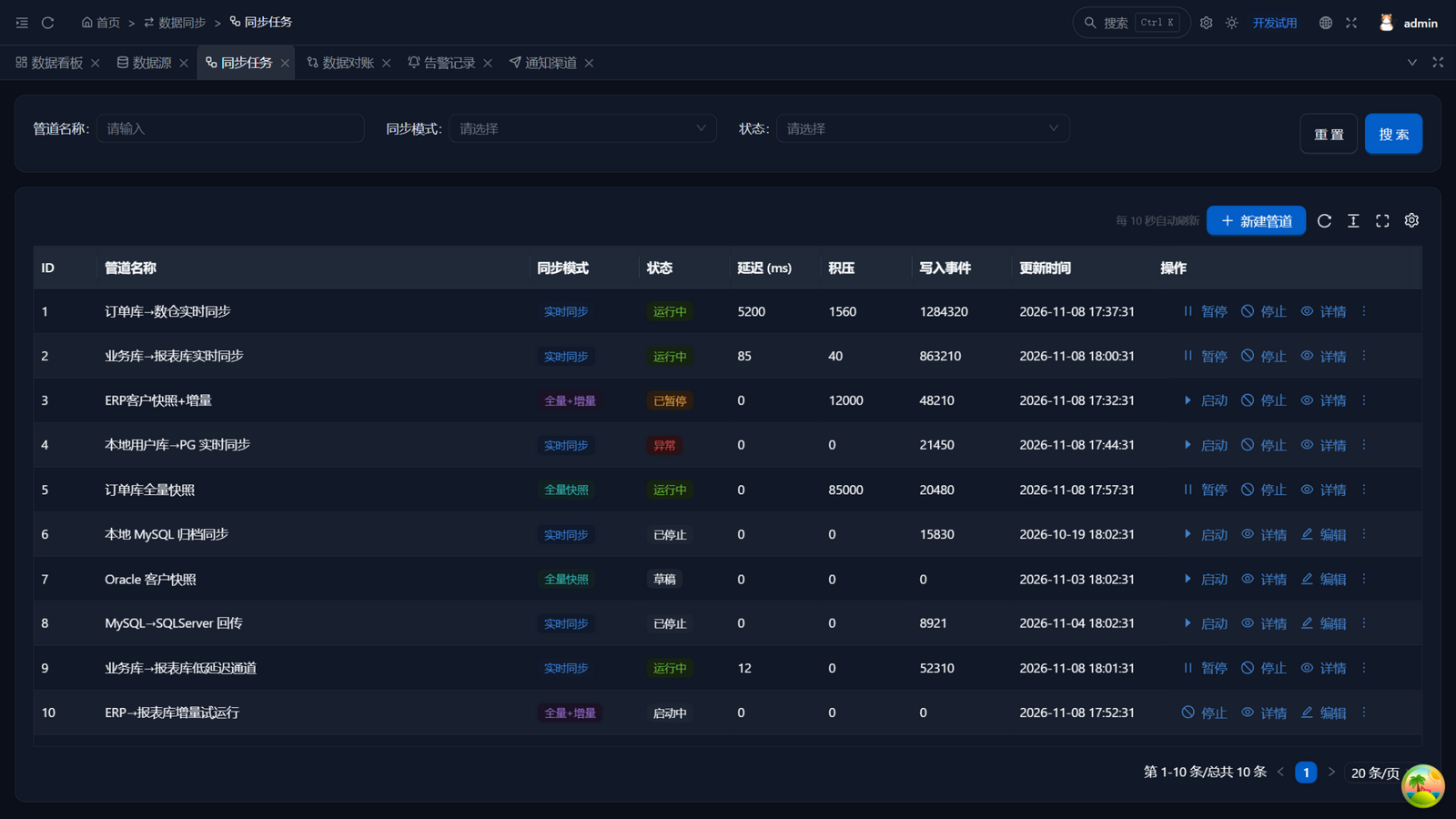 | 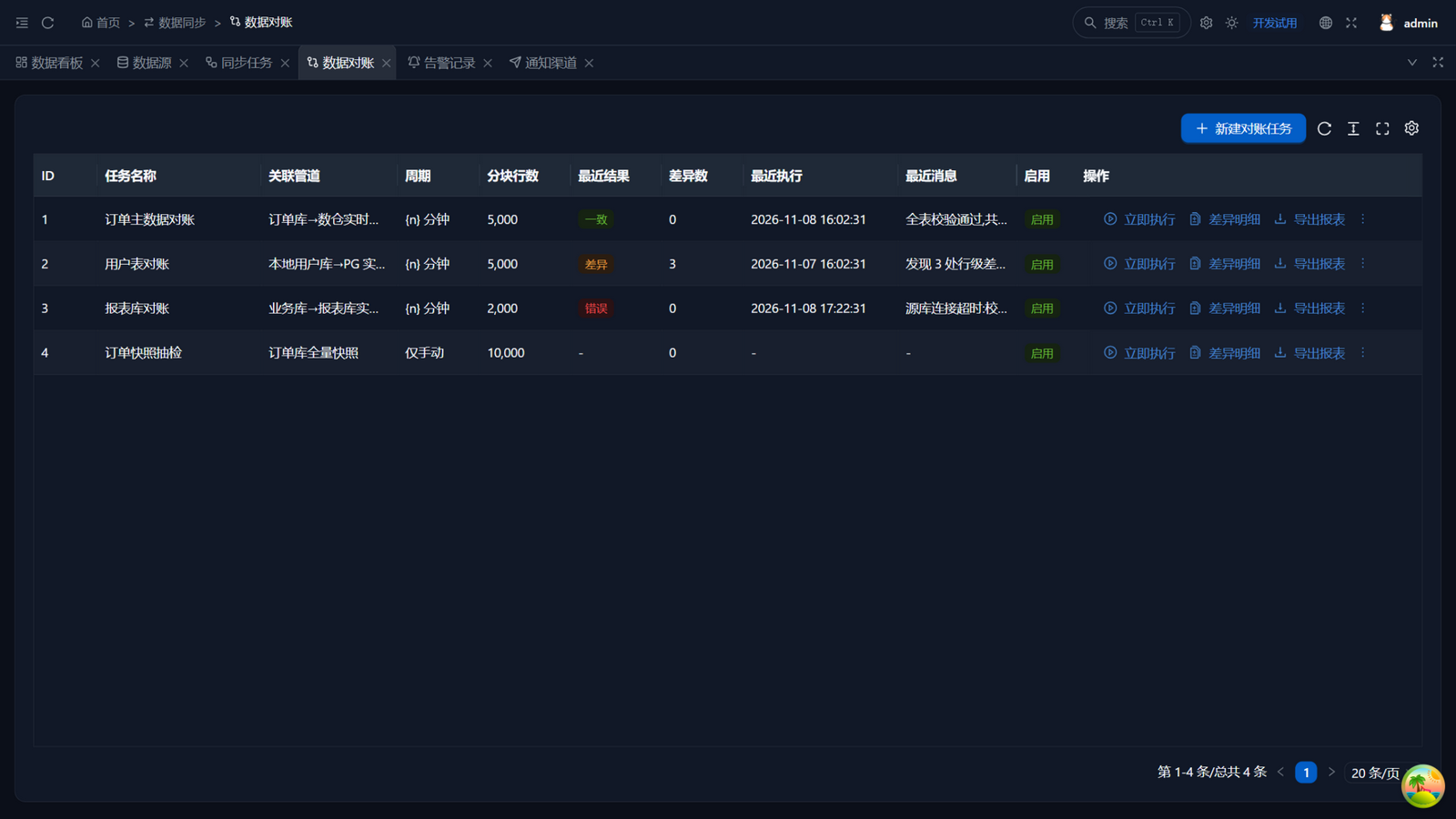 |
Alerts & Channels
| Alert Records | Channels |
|---|---|
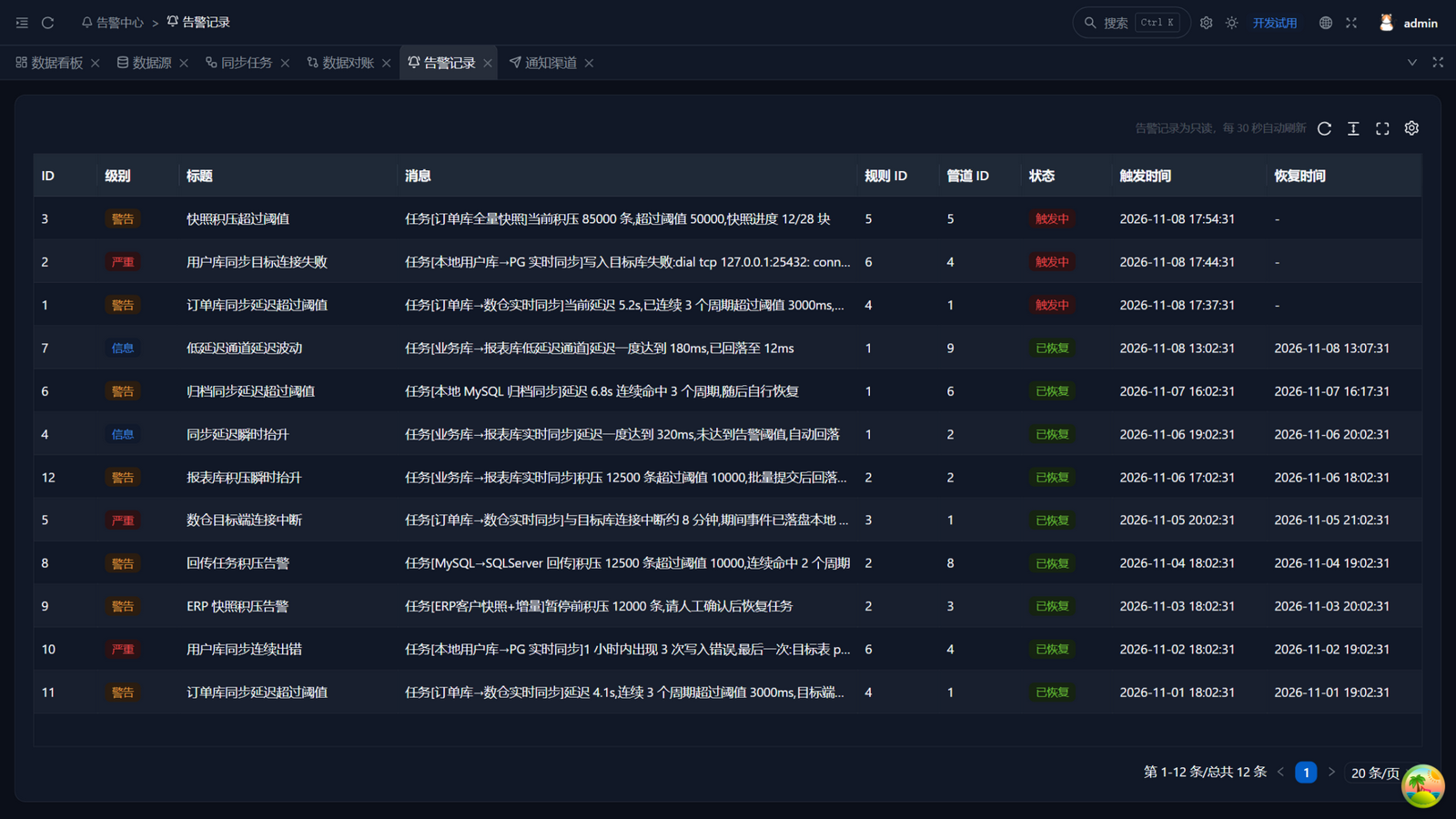 | 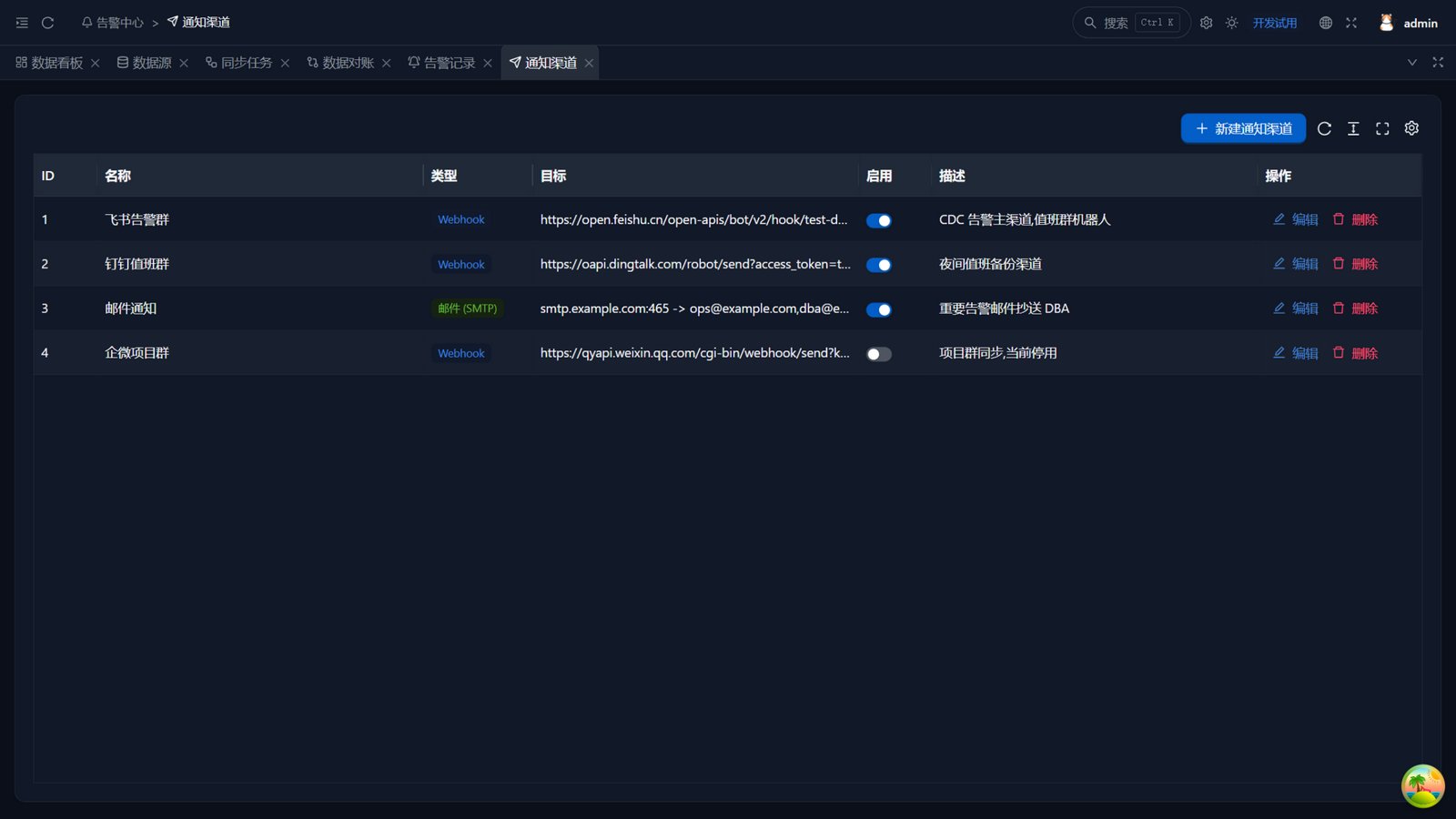 |
Use Cases
- Legacy migration: move SQL Server / Oracle estates onto PostgreSQL/MySQL with full + incremental in one pipeline, business uninterrupted
- Real-time integration: stream business-database changes into warehouses, reporting, search, and caches in seconds instead of T+1 nightly batches
- Database disaster recovery: bidirectional sync with loop-back markers for hot-standby pairs, with incremental audits keeping both sides provably consistent
- Compliant data egress: mask production data before it reaches dev/test or BI dashboards — SM3 supported
- B2B delivery: no JVM/Kafka cluster to stand up; a single box is enough, cutting delivery cost and ops surface
Delivery & Deployment
GoWind CDC ships as a private deployment and shares the same stack as the GoWind family. It runs standalone, or together with GoWind IM and GoWind Ops as a combined data-pipeline + alerting + operations solution. Deployment documentation is provided with delivery — contact us below for trials and deployment services.
Contact
Reach us on WeChat at yang_lin_bo (note CDC - Company - Name), or by email at yanglinbo@gmail.com for product trials, private deployment, and custom development.